As organizations grow, operational complexity increases, but so do the demands placed on leaders. The businesses that scale successfully recognize that leadership capacity doesn't automatically grow alongside headcount or revenue. They invest in developing leaders who can make decisions, build capability in others, and guide their teams through change, creating an organization that can grow with confidence instead of becoming constrained by its own success.
Growth is exciting. New customers. Expanding markets. Larger teams. Increasing revenue. On paper, everything points to success.
Yet this is often the stage where organizations begin to experience challenges they weren’t built to handle when they were smaller.
Decisions take longer. Senior leaders become bottlenecks. Managers hesitate to act without executive approval. Communication becomes inconsistent, priorities compete, and projects slow down, even as more people are added.
It’s understandable that the first instinct is often to look at fixing organizational structure, redesigning processes, or implementing a new technology. Those are visible problems with tangible solutions.
And sometimes those investments are necessary. But in our experience what tends to be less visible is the leadership capacity required to make those changes stick.
Scaling is fundamentally a people challenge, and more specifically, a leadership challenge.
Growth Creates Complexity. Complexity Requires Different Leadership.
In the early stages of growth, organizations often thrive because leadership is concentrated within a small group of people. They carry the vision, make most of the decisions, and stay closely connected to the day-to-day work. Communication is informal, priorities are clear, and decisions are quick, because everyone is working from the same context.
Growth changes that and the model begins to break down.
Managers suddenly find themselves leading larger, more specialized teams. They are expected to make decisions with less direct oversight, translate strategy into meaningful priorities, develop and coach their teams, and create clarity when priorities shift. The skills that made them successful as individual contributors aren't always the same skills required to lead through increasing complexity
Leadership is no longer concentrated at the top, it has to exist throughout the organization. If that capability isn't intentionally developed, growth begins to expose cracks that were easier to overlook when the organization was smaller.
Scaling Is Really About Building Leadership Capacity
One of the biggest misconceptions organizations make is assuming leadership naturally scales alongside an increase in revenue and headcount. It doesn't.
Promoting a high performer into management doesn't automatically create an effective leader. Adding another layer to the organizational chart doesn't improve decision-making. New systems won't create accountability if leaders don't know how to lead within them.
Leadership capacity is something that organizations have to build intentionally.
As organizations scale, leaders need to spend less time solving every problem and more time creating the conditions for others to succeed. The work shifts from directing tasks to building capability, creating clarity, and giving people confidence to execute independently.
Every stage of growth asks leaders to evolve before the organization can.
Organizational Readiness Is the Missing Piece
This is where change leadership becomes essential.
Many organizations prepare extensively for operational growth by investing in technology, redesigning workflows, and hiring more people. Far fewer prepare their leaders and employees to work differently.
Organizational readiness isn’t just having a project plan or implementation timeline, it’s understanding whether leaders, managers, and employees are prepared for what the change will require of them:
Some of the most valuable questions to ask include:
- Are leaders prepared for how their roles will evolve?
- Are managers equipped to lead larger, more complex teams?
- Are decision rights clear?
- Do employees understand not just what is changing, but why?
- Are leaders communicating consistently and reinforcing the same priorities?
When those conversations don’t happen, leaders often interpret the response as resistance. In reality, the answer is often something much simpler: People aren't resisting change, they're responding to uncertainty.
Leadership Development Has Become Change Leadership
Leadership development has traditionally focused on coaching, communication, delegation, and performance management.
Those skills remain essential. What’s changed is the environment leaders are expected to operate within. Few organizations go through one major transformation anymore. Today's leaders are increasingly being asked to lead people through continuous change rather than an occasional initiative.
Growth brings new priorities, evolving roles, new technology, and greater complexity.
Helping people navigate that uncertainty—while maintaining trust, engagement, and performance—is no longer a specialized skill. It is a core leadership capability.
Organizations that intentionally develop leaders who can communicate change, build commitment, and sustain momentum are far better positioned to scale successfully than those focused solely on operational improvements.
Sustainable Growth Happens When Leadership Grows Faster Than Complexity
By the time growth begins to strain decision-making, communication, or accountability, the leadership gaps already exist. The organizations that scale well don't simply build bigger businesses, They build stronger leaders before complexity exposes the need, rather than reacting once performance begins to slow.
They:
- Prepare managers before they become overwhelmed.
- Clarify accountability before decisions begin to slow.
- Strengthen communication before alignment breaks down.
- Invest in leadership capability before growth exposes capability gaps.
When leadership capability grows alongside operational growth, organizations become more resilient, more agile, and far better equipped to navigate the complexity that inevitably accompanies success.
Growth creates opportunity. Leadership determines whether an organization is truly ready to capitalize on it.
This model illustrates how organizations scale successfully:
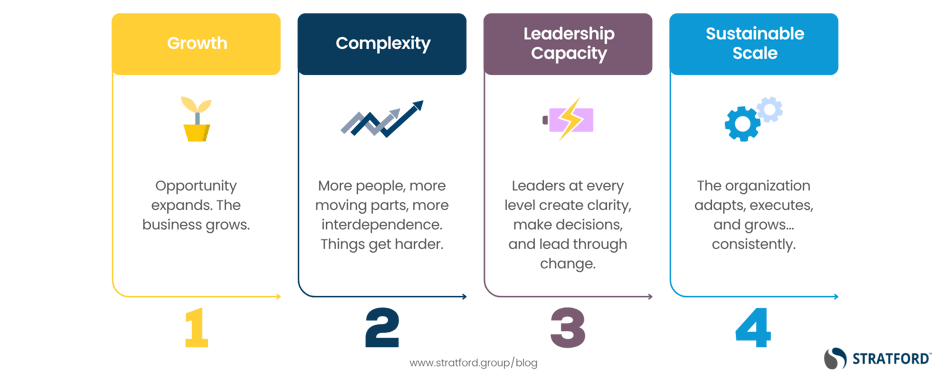
What Leaders Should Focus on at Each Stage of Growth
Understanding how leadership evolves is only part of the equation. The next step is intentionally preparing your organization before growing pains begin to appear.
| GROWTH STAGE | OPERATIONAL REALITY | LEADERSHIP FOCUS |
| Startup | Founder-led decisions | Build clarity around roles and decision-making before growth accelerates |
| Early Growth | Teams expanding | Develop first-line leaders, begin delegating meaningful decisions, and confirm operating model |
| Scaling | Multiple departments | Create consistent management practices, communication rhythms, and accountability |
| Mature Growth | Greater complexity | Strengthen cross-functional leadership, succession planning, and organizational alignment. |
No organization moves through these stages perfectly, and growth rarely follows a straight line. The important question isn't whether complexity will increase. It will. The question is whether leadership capability and capacity is keeping pace.
Leadership Growth Should Be Intentional, Not Reactive
We've seen this pattern across organizations of every size and sector.
Operational challenges usually receive the most attention because they're visible. Leadership challenges are often less obvious, but they determine whether operational improvements translate into lasting results. The organizations that scale successfully aren't necessarily those with the best strategy or the newest technology. They're the ones that recognize growth as an organizational transition, one that changes how people lead and work together—not just an operational one—and intentionally prepare both their leaders and their people for what comes next.
Leadership capacity doesn't develop on its own. It requires intentional investment, clear expectations, and practical support for leaders who are navigating increasing complexity.
Sustainable growth is achieved by developing leaders who enable people to succeed through change.
Looking to scale your leadership capacity? Let's chat about it.
About the Author: