
AI proficiency is becoming important at every level of an organization, but technology skills alone will not be enough. As AI changes how work gets done, leaders will need stronger judgement, communication and strategic thinking to help people adapt and turn new capabilities into meaningful results.
There is no shortage of advice telling leaders what they need to learn about AI. Learn prompting. Understand agents. Experiment with copilots and automation. Figure out your data. Develop an AI strategy.
Most of that advice is sensible. Leaders do need to understand the technology disrupting their organizations. But somewhere between the newest feature rollout and the next AI training session, I think we are at risk of missing something fundamental.
Useful technology is only part of the equation. The organizations that succeed with AI will will also have leaders who can adapt how they lead because of it.
AI may be changing what work gets done, who does it and how quickly it can be accomplished. But many of the capabilities leaders will rely on most are surprisingly familiar: strategic thinking, adaptability, judgement, communication, creativity, empathy, trust, and the ability to develop other people.
In other words, the future of leadership may involve considerably more AI and considerably more leadership.
I don’t think that is simply a comforting message from someone who works in leadership development. The evidence is beginning to point in the same direction.
The World Economic Forum's Future of Jobs Report 2025 found that while AI and big data are among the fastest-growing skills, employers continue to rank “analytical thinking, resilience and agility, leadership and social influence, creative thinking, and motivation and self-awareness” among the capabilities they value most. Empathy and active listening remain important too.
PwC's 2026 Global AI Jobs Barometer makes the connection even more directly. It found that as AI takes on more routine work, new tasks appearing in AI-exposed occupations are “2.5 times more likely to require human capabilities such as empathy, judgement and creativity”. It also found that the most AI-exposed junior roles are seven times more likely to demand skills traditionally associated with more senior employees, including leadership and strategic thinking.
Apparently, becoming more technological does not let us off the hook for becoming more human. That seems mildly inconvenient for those of us hoping ChatGPT might eventually handle our difficult employee conversations.
It won't. At least, it shouldn't.
So What Does an AI-Enabled Leader Actually Do?
The capabilities themselves aren't particularly exotic. In fact, most would have appeared on a list of good leadership practices long before ChatGPT arrived. What has changed is the environment in which leaders are applying them and how much is now riding on getting them right.
1. Lead people through the change, rather than simply announce it
People’s reactions to AI will not exist in neat categories. The same employee can be genuinely excited about what the technology could remove from their workload and genuinely worried about what else it could remove along with it. Those feelings may show up in the same conversation.
AI-enabled leaders need to be able to stay in that conversation and hold both realities.
That means communicating optimism about why the organization is exploring AI and what it hopes to accomplish, while being honest about what is still unknown, without pretending there won't be disruption. Employees want to understand how their work could understand how their work could change, how decisions will be made and whether they will have a voice in the process.
Leaders do not need a rehearsed answer to every question. They do need to resist filling uncertainty with vague reassurance. People are more likely to trust a leader who is candid about what is still being worked out and committed to keeping them informed.
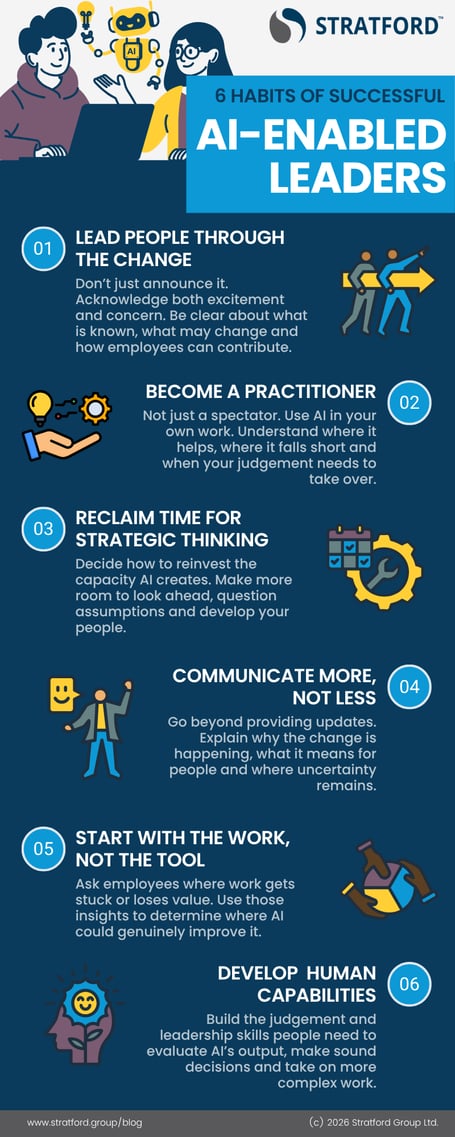
AI can help leaders broaden their thinking and/or see a question from a different angle, but the leader still owns the judgement for deciding what should be done next.
4. Communicate more, not less
AI makes it possible to produce more polished communication than anyone asked for. And it can do it almost instantly. It doesn't necessarily make communication more meaningful.
During significant change, people don't simply need more information. They need context. Why are we doing this? What does it mean for me? What is changing? What isn't? What do I need to learn? Where can I contribute?
AI-enabled leaders should expect to explain the connection between the technology and their compelling vision for the organization and its people. And they also need to listen just as deliberately as they speak.
People notice when a leader is genuinely open to hearing how a change is landing. They also notice when communication feels like an exercise in managing a reaction rather than understanding it. Trust will matter enormously in this transition. Transparency, empathy and honest conversation are how leaders earn it.
5. Start with the work, not the tool
Simply asking “Where can we use AI?” may get you a collection of abstract ideas or blank looks.
Instead, ask your team “What work gets in the way of doing your best work? Where are we duplicating effort? What frustrates our customers? What takes far longer than it should? And if AI gave you back five hours every week, what higher-value work could you do instead?” The people doing the work often know where the friction lives.
Leaders can then ask whether AI is actually the right response and what would need to change around the technology for the improvement to stick.
Similarly, inviting people to help redesign work builds ownership and surfaces opportunities leaders may never see themselves. Employees are no longer waiting to find out what AI will do to their jobs. They have an opportunity to shape how the work itself could improve.
6. Build the human capabilities AI makes more valuable
This may be the most important one, in my opinion.
The PwC finding about junior roles has a practical consequence for employers. Organizations may begin asking people to exercise more complex judgement much earlier in their careers.
At the same time, AI could absorb some of the routine work through which people traditionally learned their profession. Early-career employees often built judgement by researching, drafting, checking their assumptions and watching more experienced colleagues improve their work. If AI now handles part of that process, leaders cannot assume development will continue to happen on its own.
As AI becomes better at generating content, analyzing information and completing routine cognitive tasks, organizations need to become more deliberate about developing the capabilities that allow people to add value beyond the technology.
Someone still has to help people understand why an answer is sound, when an output should be challenged and how to make a decision when the available information is incomplete. That requires context, practice and useful feedback from people with more experience.
Strategic thinking. Judgement. Creativity. Problem solving. Communication. Collaboration. Empathy. Coaching. Adaptability.
We have traditionally called many of these "soft skills." There isn't much soft about them anymore.
Leadership teams should be asking what people need to know about AI and how their human capabilities must develop alongside it. The answers belong in leadership development plans, career pathways and everyday coaching, not only in AI training.
A Simple Starting Point for Leaders
None of this requires waiting for the organization's perfect AI strategy or commissioning a 47-item AI leadership competency model.
Start with a few habits:
-
- Use AI personally every week. Experiment with real work, not just demonstrations. Keep track of where it improves your thinking and where it creates more work.
- Talk openly about what you're learning with your team. Share the failures and limitations as well as the successes. A useful failure often starts a better conversation than a flawless demonstration
- Ask your team what work should be redesigned, rather than simply automated.
- Create space for experimentation. Make responsible learning safer than doing nothing.
- Spend some of the capacity AI creates on deeper thinking, coaching and conversation. If every saved hour disappears into more activity, the organization may become busier without becoming better.
- Invest intentionally in judgement, strategic thinking, creativity, communication and adaptability. Consider what experience they may lose as routine tasks change and how you will replace that learning.
AI is already changing job descriptions, workflows and organizations. Some of what leaders do today will be automated. New possibilities will emerge that we haven't yet imagined. And some of those changes will invite deeper conversations, making good leadership even more important. Leaders will have to explain decisions made with unfamiliar tools, judge outputs they did not create themselves and help people navigate changes that feel personal.
Access to AI will eventually become ordinary. Two organizations can use the same tools and still get very different results because their leaders ask different questions, make different choices and create different conditions for their people.
The advantage will come from what our leaders and our people are capable of doing with it. That is why I keep coming back to the same conclusion: the more AI we use, the better our leaders need to be.
Stronger AI Adoption Starts With Stronger Leadership
AI changes how work gets done and what people need from their leaders. Stratford helps organizations strengthen their leadership capability and guide people through change in a way that fits their strategy, culture and workforce.
If AI is changing what your organization expects from its leaders, it may be time to ask whether they have been prepared for it.
Let’s talk about leading well through AI-enabled change.
About the Author:
